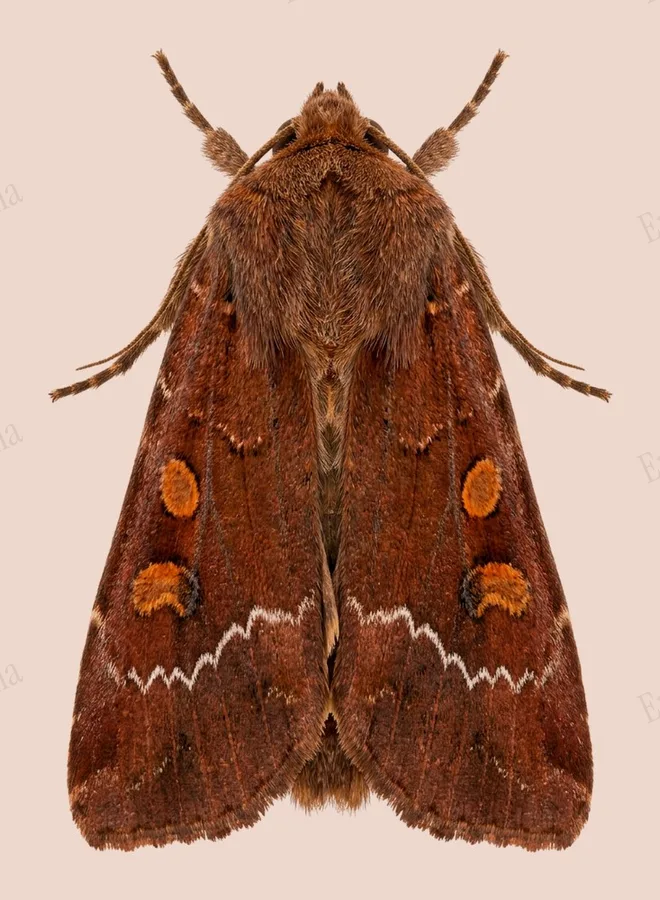
Bright-line brown-eye
Its caterpillars readily eat tomato leaves and fruit in greenhouses, earning this moth the alternate name tomato moth among gardeners across Europe.
| Where | Gardens, farmland and waste ground |
|---|---|
| Size | 34 to 44 mm wingspan |
| When | May to September |
The Bright-line brown-eye has reddish brown forewings marked with a pale, angled line near the outer edge and an orange-centered kidney-shaped spot, giving the species its descriptive name.
Caterpillars are highly polyphagous, feeding on garden vegetables such as tomato, cabbage and lettuce as well as wild plants, and the moth usually produces two generations between spring and autumn.
Traits
Habitat
Garden
Colour
Brown, Orange
Active
Night
To people
Attracted to light; harmless to people, though caterpillars can damage tomato and vegetable crops.
Activity through the year
Often confused with
Larger at 37 to 47 mm wingspan and greyer brown overall, lacking the sharp pale angled line and orange-centered spot of the Bright-line brown-eye.
Questions
Is the Bright-line brown-eye dangerous to people?
Attracted to light; harmless to people, though caterpillars can damage tomato and vegetable crops.
When can you see the Bright-line brown-eye?
The Bright-line brown-eye can be seen from May to September, at night.
Plate retouched from a photo by gailhampshire from Cradley, Malvern, U.K, CC BY 2.0, Wikimedia Commons Licence
Report a mistake in this entry
Butterflies and moths›Owlet moths›Lacanobia
Last updated 2026-09-26. Every entry is checked against published sources.