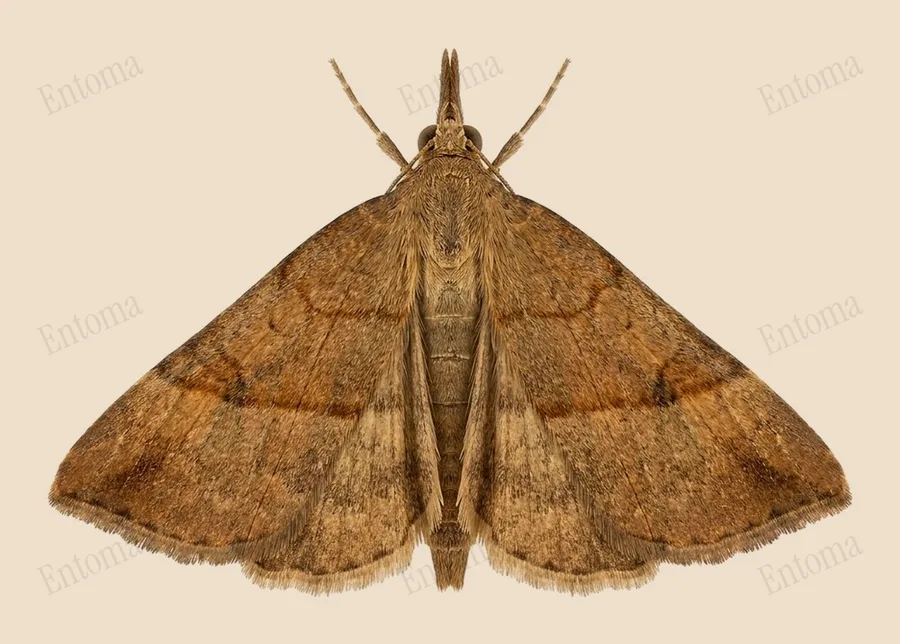
The snout
Its long, upturned mouthparts curl forward like a beak, giving the moth a snout so pronounced it names the species.
| Where | Waste ground, gardens, and woodland edge |
|---|---|
| Size | 25 to 38 mm wingspan |
| When | May to October |
The forewings are narrow and pointed, brownish with two clear cross-lines, and the moth is instantly recognisable by its long, curved, forward-pointing palps.
Caterpillars feed on common nettle, and adults are often seen flying low over patches of the plant at dusk through much of the summer.
Traits
Habitat
Grassland
Colour
Brown
Active
Night
To people
Harmless
Activity through the year
Often confused with
Buttoned snout is smaller with a wingspan of around 26 to 32 mm and shows a scalloped outer wing edge that the snout's straighter margin lacks.
Questions
Is the The snout dangerous to people?
The The snout is harmless to people.
When can you see the The snout?
The The snout can be seen from May to October, at night.
Plate retouched from a photo by Donald Hobern from Copenhagen, Denmark, CC BY 2.0, Wikimedia Commons Licence
Report a mistake in this entry
Butterflies and moths›Erebid moths›Hypena
Last updated 2026-09-26. Every entry is checked against published sources.