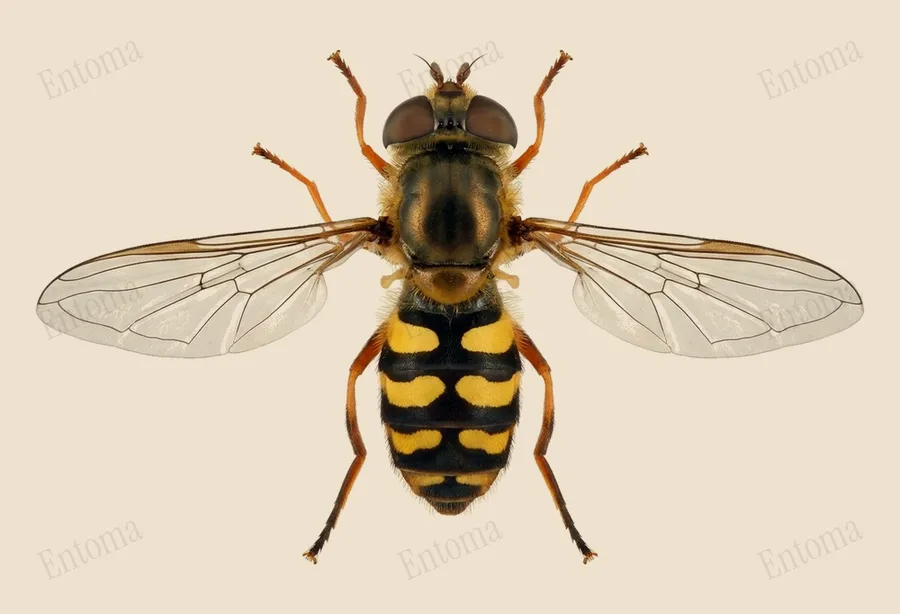
Migrant hoverfly
A single well-grown larva can eat over 300 aphids in one day, making this hoverfly one of the most effective natural aphid predators.
| Where | Gardens, farmland and open ground |
|---|---|
| Size | 6 to 11 mm long |
| When | April to August |
A small, slender hoverfly with a dark abdomen carrying yellow markings: males show broad, almost square yellow bars that often meet in the middle, while females have narrower, separate comma-shaped spots.
Females lay their eggs directly among aphid colonies, and the larvae that hatch feed on aphids for one to a few weeks before pupating nearby.
Traits
Habitat
Garden
Colour
Yellow, Black
Active
Day
To people
Harmless; valued as a natural predator of aphid pests.
Activity through the year
Often confused with
Similar in size at 9 to 12 mm, but its yellow abdominal spots stop short of the segment edge, while this species' markings reach the margin.
Questions
Is the Migrant hoverfly dangerous to people?
Harmless; valued as a natural predator of aphid pests.
When can you see the Migrant hoverfly?
The Migrant hoverfly can be seen from April to August, by day.
Plate retouched from a photo by Rego et al. (2022), CC BY 4.0, Wikimedia Commons Licence
Report a mistake in this entry
Last updated 2026-09-26. Every entry is checked against published sources.