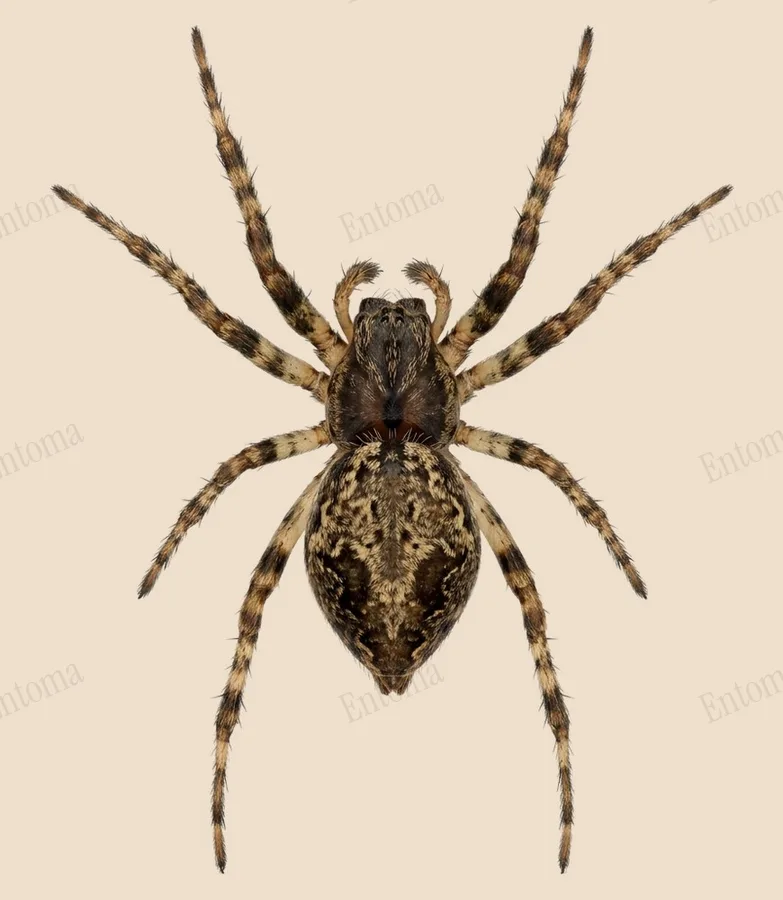
Conical trashline orbweaver
This small orb weaver strings the dried husks of its old meals into a vertical line through its web center, then hides among them, itself unseen.
| Where | Conifers and other trees in forests |
|---|---|
| Size | Female 5.3 to 8 mm, male 3.6 to 4.5 mm body length |
| When | March to November |
This small spider has a dark red brown to black abdomen, often broken up with white markings, and a single pointed tubercle at the rear that helps separate it from a similar species with a three lobed tubercle in the same genus.
It strings the drained husks of captured insects and other debris into a line through the center of its web, then sits motionless among them, so well disguised that it is often overlooked until it moves, most often on trees and especially conifers.
Traits
Habitat
Woodland
Colour
Brown, Black, White
Active
Day and night
To people
This tiny orb weaver is not dangerous to people and hides motionless among the debris on its web rather than biting.
Activity through the year
Often confused with
Has a three lobed tubercle at the rear of the abdomen with two extra small humps near the front, instead of the single simple tubercle of the conical trashline orbweaver.
Questions
Is the Conical trashline orbweaver dangerous to people?
This tiny orb weaver is not dangerous to people and hides motionless among the debris on its web rather than biting.
When can you see the Conical trashline orbweaver?
The Conical trashline orbweaver can be seen from March to November, by day and at night.
Plate retouched from a photo by Paul Cook, CC BY 4.0, iNaturalist Licence
Report a mistake in this entry
Spiders›Orb-weaver spiders›Cyclosa
Last updated 2026-09-27. Every entry is checked against published sources.