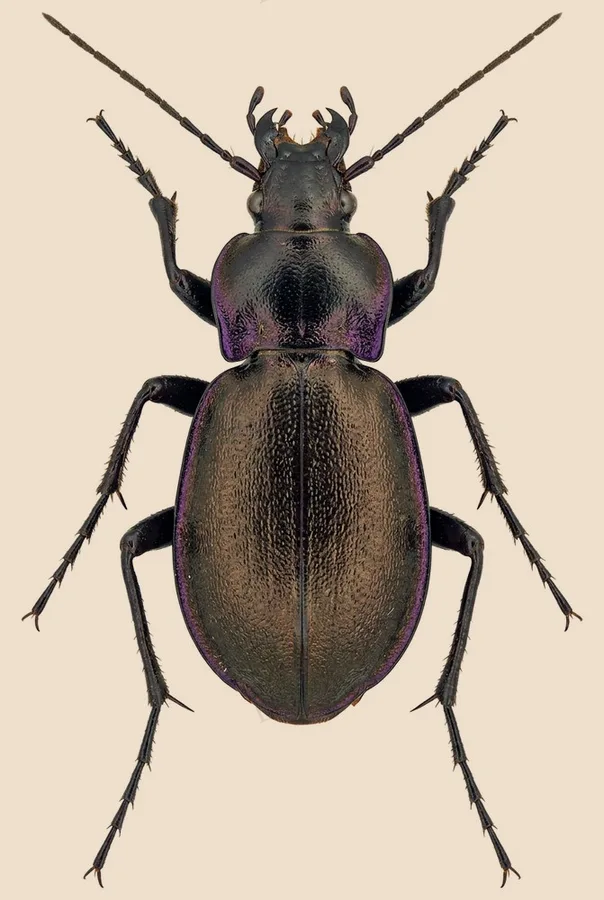
Bronze ground beetle
This nocturnal beetle hunts and eats slugs and snails that are much larger than itself, then hides under stones, bark or leaf litter by day.
| Where | Woodland, parks and gardens |
|---|---|
| Size | 22 to 26 mm body length |
| When | April to October |
The bronze ground beetle is a large, robust beetle with a bronze, green or purple sheen across its wing cases and pronotum, sometimes appearing almost black in poor light. Females often show a bluer tone across the thorax than males, and its long, thin antennae and shield shaped thorax are typical of the ground beetle family.
Active mainly at night, it forages on the ground for slugs, snails, worms and other small invertebrates, using its strong mandibles to subdue prey. It shelters by day under stones, loose bark and fallen wood, and spends the coldest months of winter dormant underground before becoming active again in spring.
Traits
Habitat
Garden
Colour
Black, Green, Metallic
Active
Night
To people
Beneficial in gardens for eating slugs and snails; not known to bite or sting people.
Activity through the year
Often confused with
Similar in size at about 18 to 30 mm, but almost entirely black with violet edges confined to the margins of the thorax and wing cases, lacking the all over bronze or green sheen of the bronze ground beetle.
Questions
Is the Bronze ground beetle dangerous to people?
Beneficial in gardens for eating slugs and snails; not known to bite or sting people.
When can you see the Bronze ground beetle?
The Bronze ground beetle can be seen from April to October, at night.
Plate retouched from a photo by Siga, CC BY‑SA 3.0, Wikimedia Commons Licence
The plate on this page is shared under the same licence as its source, CC BY-SA.
Report a mistake in this entry
Beetles›Ground beetles›Carabus
Last updated 2026-09-26. Every entry is checked against published sources.