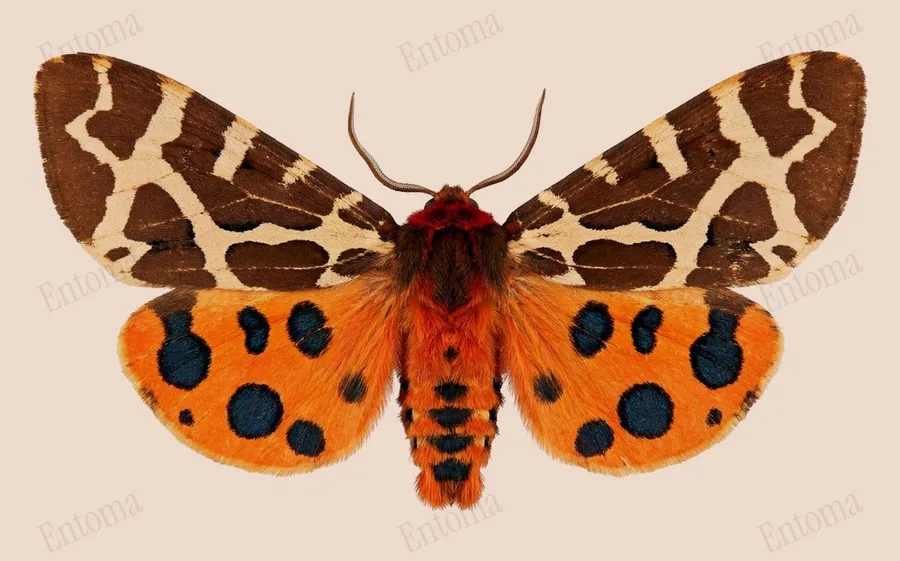
Garden tiger
Its caterpillar's irritating hairs and the adult's bright red hindwings both warn predators that this moth is distasteful to eat.
| Where | Gardens and wet meadows |
|---|---|
| Size | 50 to 78 mm wingspan |
| When | May to August |
The garden tiger is a large, heavy bodied moth with a chocolate brown, furry body and brown and white marbled forewings that conceal bright red hindwings marked with four or five large black spots, revealed only when the moth is disturbed. Its caterpillar, the woolly bear, is black and thickly covered in long black and ginger hairs.
Caterpillars feed through autumn and winter on nettles, dock, and many garden plants before pupating in spring, and the single yearly generation of adults flies at night in mid to late summer; when threatened, adults flash their red hindwings, make a rasping sound with their wings, and can release a defensive fluid from behind the head.
Traits
Habitat
Garden
Colour
Brown, Red, White
Active
Night
To people
Mild
The caterpillar's long hairs can irritate skin on contact, so it is best admired without picking it up; the adult moth is not known to bite or sting.
Activity through the year
Often confused with
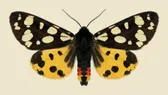
The cream-spot tiger has a smaller wingspan of 45 to 60 mm, below the garden tiger's 50 to 78 mm range, and shows black forewings with cream spots rather than the garden tiger's brown and white marbled pattern.
Questions
Is the Garden tiger dangerous to people?
Mild. The caterpillar's long hairs can irritate skin on contact, so it is best admired without picking it up; the adult moth is not known to bite or sting.
When can you see the Garden tiger?
The Garden tiger can be seen from May to August, at night.
Plate retouched from a photo by Didier Descouens, CC BY‑SA 4.0, Wikimedia Commons Licence
The plate on this page is shared under the same licence as its source, CC BY-SA.
Report a mistake in this entry
Butterflies and moths›Erebid moths›Arctia
Last updated 2026-09-26. Every entry is checked against published sources.