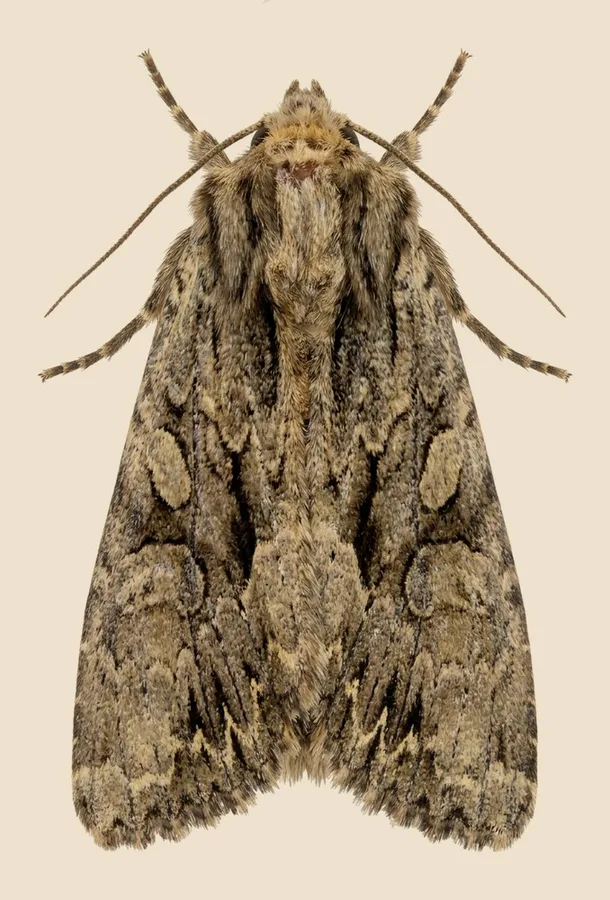
Dark arches
It is one of the most numerous larger moths recorded at light traps across its range, even though its markings vary hugely from pale ochre to almost solid black.
| Where | Grassland, gardens and waste ground |
|---|---|
| Size | 45 to 55 mm wingspan |
| When | June to September |
This large moth ranges from pale ochre-brown to blackish, always showing a bold oval and kidney-shaped mark plus a deep W-shaped line near the outer wing edge, with a wingspan of 45 to 55 mm.
Caterpillars feed inside grass stems and roots, overwintering before pupating in spring, and the species is strongly associated with grassy places of all kinds.
Traits
Habitat
Grassland
Colour
Brown, Black
Active
Night
To people
Harmless
Activity through the year
Often confused with
The clouded-bordered brindle is smaller, with a wingspan of about 36 to 44 mm against the dark arches' 45 to 55 mm, and shows a paler band along the wing margin.
Questions
Is the Dark arches dangerous to people?
The Dark arches is harmless to people.
When can you see the Dark arches?
The Dark arches can be seen from June to September, at night.
Plate retouched from a photo by Ben Sale from Stevenage, UK, CC BY 2.0, Wikimedia Commons Licence
Report a mistake in this entry
Butterflies and moths›Owlet moths›Apamea
Last updated 2026-09-26. Every entry is checked against published sources.